-
Acoustic Wall Panels Manufacturer Sourcing: An FAQ From a Quality Inspector
-
Q1: How do I filter acoustic wall panel manufacturers before I request samples?
-
Q2: What do I need to know about custom dimensions before I order?
-
Q3: What's different about acoustic wall panels for offices versus other spaces?
-
Q4: Wood acoustic panels vs decorative acoustic panels—how do I choose?
-
Q5: Can I trust the acoustic performance claims on a spec sheet?
-
Q6: Is it worth paying more for a higher-quality panel?
-
Q7: What would you do differently on your next custom order?
Acoustic Wall Panels Manufacturer Sourcing: An FAQ From a Quality Inspector
I've reviewed over 300 batch deliveries of acoustic wall panels since 2022. My job is signing off on quality before panels reach a project site. In 2024, I rejected 18% of first deliveries—mostly on dimension mismatches and finish inconsistencies.
Here's what buyers actually ask me, in the order I'd answer them:
Q1: How do I filter acoustic wall panel manufacturers before I request samples?
Most sourcing guides say compare ASTM test reports first. In practice, I check their QC process before I look at a single acoustic rating.
Ask three things: Do they have an in-house dimension check step (not just "we check every order")? Can they show you a rejected batch with photos and rework notes? And what's their typical tolerance on custom sizes—plus or minus what?
A manufacturer without documented QC steps will talk up a pile of certifications. One with real process will send you the rework log. That's a bigger signal than any lab number they print on a brochure.
Q2: What do I need to know about custom dimensions before I order?
Custom sizing is where most first deliveries go wrong. A good manufacturer quotes dimensions in both imperial and metric, confirms critical tolerances in writing, and flags any size that pushes beyond their standard production run.
Here's what surprised me: the tolerance issue isn't usually a manufacturing problem. It's an interpretation problem. Our spec might say "24 inches nominal." Basically, the factory reads that as exactly 24.0 (in other words, no wiggle room). Our finish subcontractor expects to land at 24.0 and still have adjustment space. Those are different expectations.
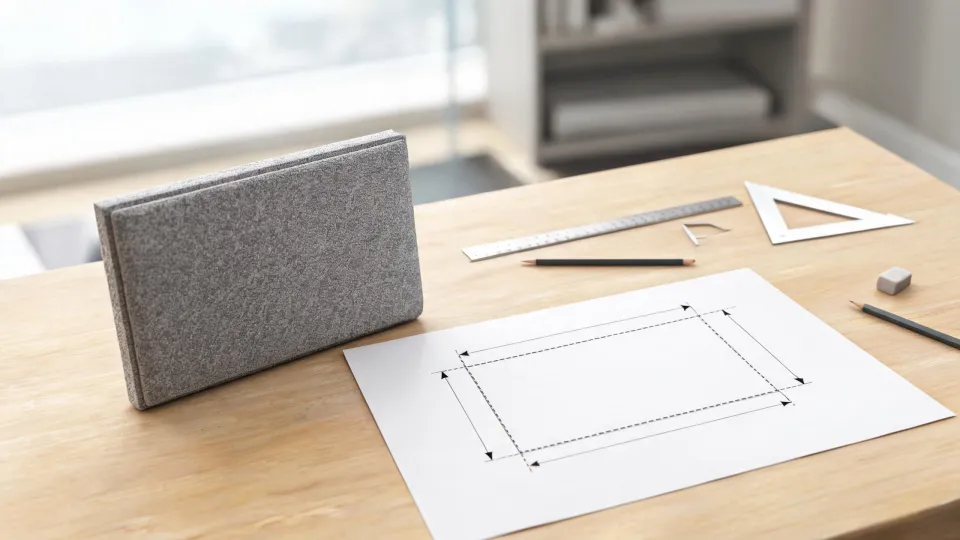
Now every contract includes a labeled dimension diagram with explicit tolerances. That one change dropped our sizing rejections from 22% to under 6%.
Q3: What's different about acoustic wall panels for offices versus other spaces?
Office acoustic panels need to survive contact—chairs, cleaning crews, the occasional ladder. Fire ratings also matter for commercial occupancy, and those vary by region.
But the biggest office-specific issue I see is mounting method. A panel rated for adhesive install may not perform the same with impaling clips. I used to think acoustic performance was panel-only. Then we tested identical panels mounted three ways—performance varied enough that mounting had to be documented in the spec.
Check NFPA or local code before selecting a wood-finish panel, too. Some wood substrates pass impact testing but fall short on Class A flame spread.
Q4: Wood acoustic panels vs decorative acoustic panels—how do I choose?
This isn't a quality question. It's a use-case question.
Wood acoustic panels (veneer or laminate) look great and cost more. Decorative acoustic panels (fabric-wrapped, perforated metal, or composite) offer better acoustic absorption per square foot in most office applications, and they tend to hide damage way more forgivingly than veneer.
I have mixed feelings about this, honestly. On one hand, wood-finish panels close office leases—clients see them and think "premium." On the other, the decorative fabric panels consistently outperform them on NRC values. If the room needs acoustic function more than visual impact, fabric or perforated wins. If it's a client-facing space and the acoustics are already handled elsewhere, wood earns its cost.
Q5: Can I trust the acoustic performance claims on a spec sheet?
Per FTC guidelines (ftc.gov), any performance claim—including acoustic ratings—must be truthful, substantiated with evidence, and not misleading. That means a manufacturer claiming a specific NRC value should be able to point to a test report matching the product thickness, substrate, and mounting method you're buying.
Where this falls apart: a manufacturer tests a 2-inch panel with one mounting method, then quotes the same rating for their 1-inch panel with a different clip system. The number is real. The claim isn't.
Ask for the test report page that specifically matches your configuration. If they can't produce it, treat the rating as decorative.
Q6: Is it worth paying more for a higher-quality panel?
A colleague once told me that clients only notice acoustic panels when they're broken. I believed that for about two years. Then I watched a premium install and a budget install sit side by side in the same lobby renovation.
The difference wasn't acoustic—it was edge quality (which, honestly, took me two years to notice). The premium panels had clean, tight seams and consistent finish. The budget ones had visible gaps and slight color variation between batches. Nobody commented on either one verbally. Plus, the property manager was super direct about wanting the premium supplier's contact for the next building.
Looking back, I should have tracked client perception earlier instead of assuming function was the only metric. That said, budget panels have their place—stock rooms, back-of-house corridors, temporary spaces. Just don't put them where clients form first impressions.
Q7: What would you do differently on your next custom order?
I'd schedule the quality inspection earlier. On our first large custom-dimension order, we didn't inspect until panels arrived on-site. Three out of forty were off—not enough to reject the whole batch, but enough to force a rework and delay our install by nine days.
Even after switching to a new supplier, I kept second-guessing. What if the new factory's tolerance drifted after the first few runs? It took three clean deliveries before I stopped worrying.
If I could redo that first order, I'd pay for a factory-side inspection at production, not at delivery. The cost was around $600 for a third-party visit. The delay cost us way more than that in schedule penalties alone.
Bottom line for manufacturer sourcing: ask for process, not just certifications. Confirm dimensions in writing with explicit tolerances. And treat the decorative-versus-wood choice as a brand decision as much as an acoustic one.
