The comparison, up front
If you're sourcing decorative acoustic wall panels for an office project, you've probably noticed two camps. Camp A is the direct manufacturer model — a factory or sourcing agent that builds to your dimensions, ships on a quoted lead time, and usually beats stock pricing at volume. Camp B is the local stock distributor — panels in a warehouse, same-week availability, and a relationship you can call on Tuesday afternoon.
For six years, our firm has ordered from both. Not because we're indecisive. Because the right answer kept changing with the project.
Here's what I'm comparing on: sticker price vs. total cost, delivery certainty, and custom dimensions plus spec match. Each one produced a clear winner in our data — and one of them surprised me.
Where this comes from: I'm a procurement manager at a 340-person architecture firm. I've managed our interior finishes and materials budget ($220,000 annually) for 7 years, negotiated with 40+ vendors, and logged every order in our cost tracking system. This is from that log, not from a supplier's pitch deck.
Dimension 1: Sticker price vs. total cost
On unit price, direct manufacturing wins. No contest. Our average landed cost for a 24" × 48" wood-faced panel, 9mm substrate, came in around $62 direct from manufacturer versus $89 from the local distributor on comparable spec. That's a 30% delta before freight.
But sticker price isn't the number that hits the budget line. In 2023 I audited our panel spend and found the "cheap" direct orders had a hidden-tax problem: short shipments (we'd reorder at small quantity, losing volume pricing), mixed-batch color variation (we'd reject and replace, sometimes twice), and damage-in-transit that the factory blamed on freight and freight blamed on the factory.
The local distributor price was all-in. Delivered, inspected, and — critically — returnable. When a box arrived with a chipped edge, it was a phone call, not a claim.
Bottom line: above about 200 panels per project, direct wins on TCO even with a 5–10% rejection rate. Below that, the distributor's convenience premium is often cheaper than the cost of managing a factory order yourself. I want to say our crossover point is 180 units, but don't quote me on that — I'd have to pull the spreadsheet.
Dimension 2: Delivery certainty (the one that surprised me)
Here's what I expected: local = fast, direct = slow.
Here's what actually happened for 4 of our last 6 office projects. The direct manufacturer's quoted lead time — 6 to 8 weeks with a scheduled ship date — was more reliable than the local distributor's "should be in stock next week."
The "local is always faster" thinking comes from an era before modern freight and scheduled manufacturing. Today, a well-run factory with a firm ship date can beat a disorganized local distributor, and our data says it usually does.
The surprise wasn't the lead time itself. It was the certainty.
Let me put it in numbers. On our Q3 2023 office refit — decorative walnut panels for a client-facing lobby, 340 units — the local distributor quoted two weeks. It took seven. We lost the schedule on a Friday walkthrough because the panels weren't in the ceiling grids. The GC billed us a $4,800 delay penalty. We ate it. The direct manufacturer we'd used the two previous quarters had given us a firm ship date and missed it by two days.
The procurement lesson: a firm date with a penalty clause is worth a premium. A soft "probably next week" is a red flag dressed as flexibility.
So on the certainty dimension, direct won for us — not because it was faster, but because it was predictable. If you've ever had a "should be fine" delivery blow up a walkthrough, you know exactly what I'm talking about.
Dimension 3: Custom dimensions and spec match
This is where direct sourcing stops being a price play and becomes the only real option. If your panels need to hit a specific ceiling grid, wrap a soffit, or fit an irregular wall — and in office design they almost always do — stock dimensions cost you more in filler panels and detail work than custom would have cost up front.
Our last 5 office projects used non-standard dimensions: 22.5" × 60", 18" × 72", and one L-shaped acoustic baffle no distributor would touch. Direct manufacturers quoted 10–14 days to produce after drawing approval. The local distributor's answer was "we can cut standard stock" — which meant visible seams and a lead time that quietly stretched to three weeks.
The catch: custom dimensions only work if you specify them properly. We had a $3,400 order come back wrong in 2022 because our PO said "wood acoustic panel, custom size" without calling out grain direction. The manufacturer built it to the dims, not the grain. That's on us.
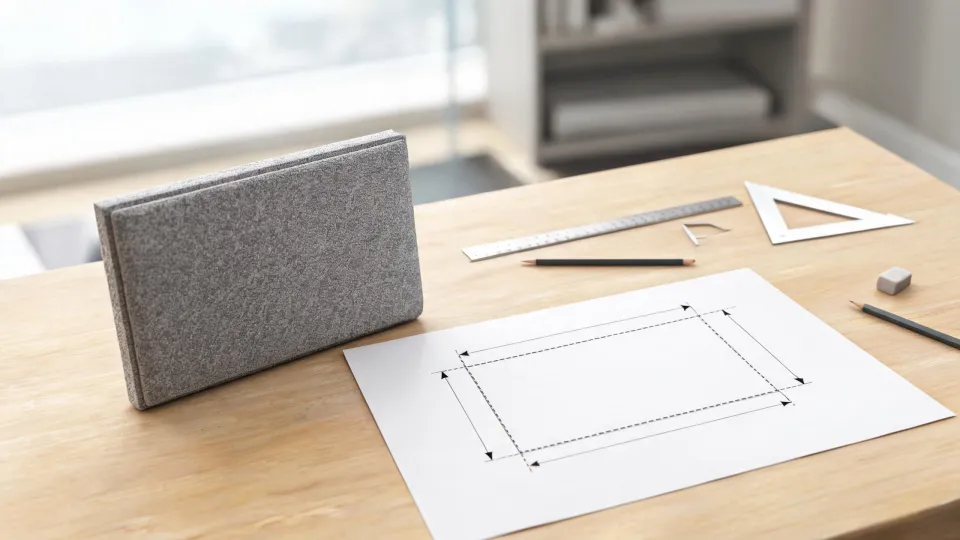
The most frustrating part of this whole process: the same spec-match problems kept showing up across different vendors. You'd think a written PO with dimensions would prevent mismatches. It doesn't — interpretation still varies. What finally helped was attaching a marked-up drawing to every panel order, not just a text spec. Rejections dropped to near zero after that.
One compliance flag worth raising: acoustic ratings on spec sheets are advertising claims, and per FTC advertising guidelines (ftc.gov), claims like NRC or acoustic performance values must be substantiated with real test data — not rounded up from a brochure. Before we approve any custom panel now, procurement requests the lab report. Two manufacturers in our last bid round couldn't produce one. That was a deal-breaker.
So which model wins?
Neither. That's the honest answer, and it's the one I'd give a colleague in the hallway.
Here's how we decide now:
- Direct manufacturer sourcing if: you have 6+ weeks, 200+ panels, or non-standard dimensions. The TCO math favors direct once volume clears the rejection-rate threshold, and certainty has consistently beaten the "fast" local option in the projects we've tracked.
- Local stock distributor if: you have a small order (under ~50 panels), a short fuse, or a client who needs to see and touch the sample. The convenience premium is real, and on small jobs it's a no-brainer.
- Split order if: the project has a standard-dimension core plus a few statement pieces. We've done this twice — stock panels locally, focal elements from the manufacturer — and it's the best of both, if you can manage two delivery schedules.
What I'd actually tell you — and it took me about 3 years and 30 panel orders to really believe this — is that the "cheapest" quote and the "fastest" quote are both usually illusions until you put them on one spreadsheet. What I mean is that the number that matters isn't the unit price at all. It's the cost of the whole job being finished on time, with the panels installed the way they were drawn, and the cost of your own time chasing the vendor at 4:30 on a Friday — which is never zero.
Price the certainty. In our experience it's almost never the wrong call.
